
- DER Electrical Infrastructure
The Electrical Equipment That Makes Your DER System Work
AMRENERGY engineers, supplies, and installs the complete electrical infrastructure for C&I DER systems — switchgear, inverters, transformers, automatic transfer switches, metering, and all balance-of-system components — specified, coordinated, and monitored as a unified system.
480V–35kV
Voltage Range
UL / IEEE
Standards Compliance
NEC 2023
Code Compliance
MODBus
DERMS Integration
Why Electrical Equipment Matters
Every DER System Is Only as Reliable as Its Electrical Infrastructure
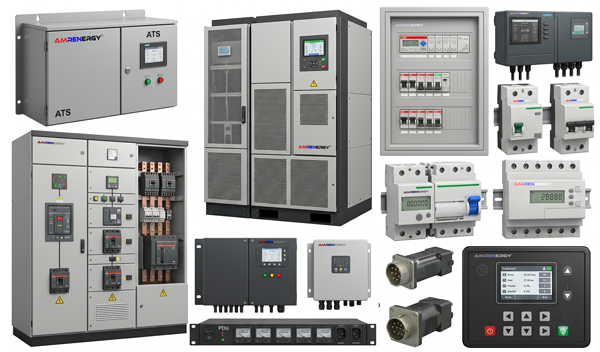
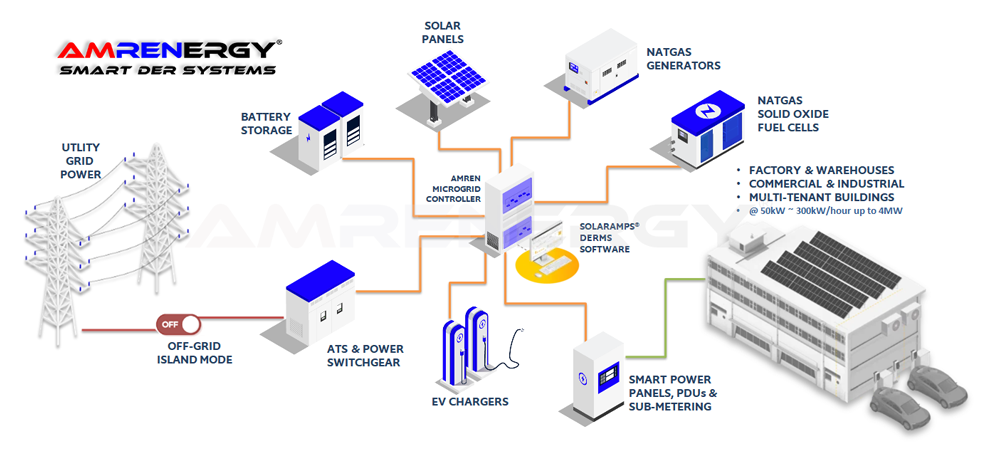
Solar panels, batteries, fuel cells, and generators generate and store power. But none of it reaches your facility safely or efficiently without the right electrical equipment — switchgear that protects the system, inverters that convert DC to grid-compatible AC, transformers that step voltage for distribution, transfer switches that manage source transitions, and metering that feeds the data for intelligent optimization.
AMRENERGY specifies, sources, and installs all electrical balance-of-system (BoS) equipment as an integrated part of your DER system design. Every component is selected for compatibility with your generation assets, your facility’s existing infrastructure, your local utility interconnection requirements, and our DERMS monitoring platform.
The result is an electrical system that is code-compliant, utility-approved, and fully monitored from day one — with a single point of accountability from the inverter to the switchboard.
Equipment Categories
Complete Electrical Infrastructure for C&I DER Systems
Solar & Storage Inverters
String, central, and three-phase inverters convert DC power from solar arrays and battery systems to grid-compatible AC. AMRENERGY specifies inverters with the right efficiency curve, grid-forming capability, and reactive power control for your installation.
String Inverters
Central Inverters
Hybrid Inverters
Grid-Forming
IEEE 1547
Automatic Transfer Switches (ATS)
ATS units monitor grid voltage and frequency, automatically switching your facility to on-site generation within milliseconds of a grid anomaly. AMRENERGY integrates open-transition and closed-transition ATS for different load criticality levels.
Open Transition
Closed Transition
Bypass-Isolation
UL 1008
NEMA 3R / 4
Switchgear & Switchboards
Commercial and medium-voltage switchgear protects your DER system and facility electrical infrastructure. AMRENERGY selects and installs low-voltage and medium-voltage assemblies rated for your system's fault current levels and operational requirements..
LV Switchgear
MV Switchgear
480V–35kV
UL 891
ANSI C37
Distribution Transformers
Step-up and step-down transformers match generation and storage output voltages to your facility's distribution voltage and utility interconnection requirements. AMRENERGY engineers transformer sizing and impedance for DER grid interconnection compliance..
Pad-Mount
Dry-Type
Step-Up / Down
IEEE C57
DOE 2016
Revenue-Grade Metering & Sub-Metering
Accurate revenue-grade metering captures solar generation, battery throughput, generator output, and facility consumption for utility compliance, incentive verification, and DERMS optimization. Sub-metering enables per-tenant billing allocation.
Revenue-Grade
ANSI C12
Sub-Metering
PMU Integration
MODBus RTU
Protection Relays & Overcurrent Devices
Protective relaying coordinates fault isolation across your DER system — preventing cascading failures and ensuring IEEE 1547 anti-islanding compliance. AMRENERGY conducts protection coordination studies to confirm correct relay settings for your interconnection.
Relay Coordination
Anti-Islanding
IEEE 1547
Arc Flash Studies
NFPA 70E
DC Combiners & String Monitoring
DC combiner boxes aggregate multiple solar string outputs before feeding the central inverter, with integrated string-level monitoring and fusing. AMRENERGY specifies configurations that maximize performance visibility and simplify fault diagnosis.
String Combiners
DC Disconnects
AFCI Protection
NEC 690
String Monitoring
Energy Management & Control Panels
DER control panels house the AMREN microgrid edge controller, communication modules, human-machine interfaces, and integration wiring that connect all generation and storage assets to our DERMS platform for real-time monitoring and dispatch control.
Edge Controller
HMI Display
SCADA Integration
UL 508A
NEMA 4X
Standards & Compliance
Engineered to Every Applicable Standard
Commercial and industrial DER electrical equipment must comply with utility interconnection, safety, arc flash, equipment rating, and grid code requirements. AMRENERGY’s engineering team ensures every component selection, installation, and commissioning step meets or exceeds applicable standards — streamlining utility approval and permitting.
- IEEE 1547 — Grid Interconnection
- NEC 2023 — National Electrical Code
- UL 1741 — Inverter Certification
- UL 1008 — Transfer Switches
- ANSI C12 — Metering Standards
- ANSI C37 — Switchgear Standards
- IEEE C57 — Transformers
- NFPA 70E — Arc Flash Safety
- NEMA 3R / 4 / 4X — Enclosures
- DOE 2016 — Transformer Efficiency
- NEC 690 — Solar PV Systems
- NEC 706 — Battery Storage
The AMRENERGY Advantage
One Engineer. One Contract. One System That Works.
When electrical equipment is specified by one party, installed by another, and monitored by a third, accountability gaps create costly failures — mismatched protection settings, incompatible communication protocols, and equipment that was never designed to work together. AMRENERGY eliminates these gaps by engineering your complete electrical infrastructure as a system, not a collection of components.
Every piece of electrical equipment AMRENERGY supplies is selected, configured, and tested to work with every other component in your DER system — and with the AMRENERGY DERMS platform — before it leaves our staging facility.
01Pre-Configured and Factory-Tested
Equipment is staged, programmed, and pre-tested at our facility before shipping — reducing on-site installation time and eliminating field configuration errors.
02Protection Coordination Included
AMRENERGY conducts arc flash and protection coordination studies for every installation — ensuring correct relay settings and NEC/NFPA 70E compliance from day one.
03Utility Interconnection Management
We manage the complete utility interconnection application process — from initial application through final approval — using in-house licensed electrical engineers.
04DERMS Integration Out of the Box
Every electrical component is pre-configured to communicate with AMRENERGY's DERMS platform. Real-time monitoring starts the day your system comes online.
Project Lifecycle
How AMRENERGY Delivers YourElectrical Infrastructure
Step 01
Electrical Assessment
We review your existing single-line diagram, utility interconnection requirements, and load schedule to establish the electrical design basis.
Step 02
Engineering Design
Stamped single-line diagrams, equipment specs, arc flash study, and protection coordination study — all produced in-house by licensed engineers.
Step 03
Equipment Procurement
AMRENERGY procures and pre-configures all electrical equipment from vetted OEM suppliers, staging and testing at our facility before delivery.
Step 04
Permitting & Utility Approvalt
We manage electrical permit applications, AHJ coordination, and utility interconnection agreements from submission through approval.
Step 05
Installation & Commissioning
Licensed electricians install per AMRENERGY drawings, followed by comprehensive commissioning testing before Permission to Operate.
Step 06
O&M & Monitoring
All equipment connects to AMRENERGY DERMS for 24/7 performance monitoring, fault detection, and preventive maintenance scheduling.
Applications
Electrical Equipment Solutions forEvery C&I Facility Type
Solar + Storage Installations
Complete BoS electrical for rooftop, carport, and ground-mount solar with integrated battery storage — from string combiners through utility interconnection switchgear.
Generator Paralleling Systems
Synchronization switchgear, paralleling controls, and automatic transfer switches for facilities running multiple generators or operating in island mode.
Campus and Multi-Building Microgrids
Medium-voltage distribution switchgear and metering infrastructure for campus microgrids serving multiple buildings from a centralized DER system.
EV Fleet Charging Infrastructure
Service entrance upgrades, distribution panels, sub-metering, and demand management equipment for commercial EV fleet charging depots.
Utility Interconnection Upgrades
New or upgraded point-of-interconnection equipment — transformers, switchgear, metering — to meet utility requirements for C&I DER installations.
Critical Facility Upgrades
Redundant electrical infrastructure, bypass-isolation transfer switches, and protection upgrades for data centers, hospitals, and mission-critical facilities.
Let's Engineer Your Electrical Infrastructure Right the First Time
AMRENERGY’s licensed electrical engineers will assess your facility’s electrical system and design the optimal infrastructure for your DER installation.
FAQ
Common Questions AboutDER Electrical Equipment
What is balance-of-system (BoS) equipment in a DER installation?
Balance of system refers to all the electrical components in a DER installation other than the primary generation or storage equipment itself — inverters, transformers, switchgear, wiring, conduit, combiners, meters, disconnect switches, and control panels. BoS equipment typically represents 30–50% of a DER system’s total installed cost, and its quality and specification significantly affect system reliability, efficiency, and service life.
Does AMRENERGY handle utility interconnection applications?
Yes. AMRENERGY manages the complete utility interconnection process, including the interconnection application, required engineering studies (protection coordination, short-circuit, load flow), coordination with the utility’s engineering department, and obtaining final interconnection approval before commissioning. This is included in AMRENERGY’s turnkey EPC scope.
What arc flash study services does AMRENERGY provide?
AMRENERGY conducts arc flash hazard analysis per NFPA 70E and IEEE 1584 for all new DER electrical installations. The study establishes incident energy levels at each switchboard and panel, enabling proper PPE labeling and safe work practices. Arc flash studies are required by NFPA 70E and are included in AMRENERGY’s engineering scope for all C&I DER installations.
Can AMRENERGY upgrade an existing electrical service for a new DER system?
Yes. Many C&I facilities require service entrance upgrades, new distribution panels, or medium-voltage infrastructure changes to accommodate a DER addition. AMRENERGY’s electrical engineers assess your existing infrastructure, identify required upgrades, and include them in the overall DER system design and construction scope.
How does metering equipment connect to AMRENERGY's DERMS platform?
Revenue-grade meters and sub-meters are configured to communicate via MODBus RTU or TCP/IP to the AMREN edge controller installed at your site. The edge controller aggregates all meter data and forwards it to the AMRENERGY DERMS cloud platform, where it is used for real-time optimization, performance reporting, and sub-metering billing — typically with 15-second data resolution.