
- Commercial Battery Energy Storage
Stop Overpaying for Peak Power with
Commercial Battery Storage
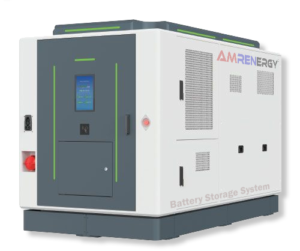
AMRENERGY designs and delivers behind-the-meter Battery Energy Storage Systems (BESS) that eliminate demand charges, provide backup power, and enable grid independence — all integrated into your C&I DER strategy.
50kW–4MW
System Capacity Range
1ms ~ 2ms
Grid Switchover Speed
24/7
DERMS Monitoring
Flexible
Financing Options
The Problem Battery Storage Solves
Demand Charges Can Represent 30–50% of Your Electricity Bill
Most commercial and industrial utility customers pay two kinds of electricity costs: energy charges (kWh consumed) and demand charges (kW peak draw). Demand charges are set by a single 15–30 minute peak each month — and utilities charge for them whether or not you sustain that peak for the rest of the month.
AMRENERGY battery storage systems discharge during peak demand windows, shaving your facility’s demand peak before the utility can measure it. The result: a dramatically lower demand charge on every bill, month after month — without changing how your facility operates.
Storage Applications
What Your Battery System Does for You
Peak Demand Shaving
The battery discharges automatically during your facility's peak load windows, reducing the maximum kW draw recorded by the utility. Demand charges drop — often by 30–50% — with zero operational changes on your end.
30–50% demand charge reduction
Time-of-Use (TOU) Optimization
Charge the battery during off-peak hours when electricity is cheap. Discharge during on-peak periods when rates are high. AMRENERGY's DERMS software automates this in real time, maximizing your savings every day.
Avoid peak TOU rate windows
Backup Power & Resilience
When the grid goes down, your battery system can island your facility and maintain power to critical loads — keeping operations running, refrigeration online, and safety systems active — switching in milliseconds.
Millisecond switchover time
Solar Firming & Excess Storage
When paired with AMRENERGY solar, the battery captures excess solar generation instead of exporting it at low net-metering rates, then discharges it when solar output drops — extending the value of your solar investment.
Maximize solar ROI
Demand Response Revenue
In markets where demand response programs are available, your battery system can participate — dispatching stored energy to the grid during grid stress events and earning revenue or bill credits from your utility.
.
Earn grid services revenue
EV Fleet Charging Support
EV fleet charging creates massive demand spikes that utilities penalize heavily. Battery storage absorbs those spikes, enabling fast charging of your fleet without blowing out your demand charge ceiling.
Enable fleet electrification
Make the Business Case
Battery Storage vs. Paying Full Utility Demand Charges
- Capability
- Demand charge exposure
- TOU rate management
- Backup power during outage
- Solar integration
- Grid services revenue
- Energy cost predictability
- Grid Only (No Storage)
- Full peak kW billed monthly
- Pay whatever time-of-use rate applies
- No power — operations halt
- Excess solar exported at low rates
- Not available
- Volatile — rises with utility rates
- AMRENERGY Battery Storage
- Prime + Standby
- Diesel tank required
- Critical loads maintained in ms
- Excess stored and self-consumed
- Demand response participation
- Stable, optimized cost of power
System Integration
Fully Integrated with AMRENERGY's DERMS Platform
Every AMRENERGY battery system communicates in real time with our proprietary DER Management Software (DERMS), which coordinates charging and discharging decisions based on energy prices, demand forecasts, solar output, grid signals, and your facility’s load profile.
The result is a system that optimizes itself continuously — without manual intervention — to deliver the lowest possible cost of electricity at all times.


- Real-time demand forecasting and automatic peak shaving dispatch
- Coordinated control with solar, fuel cells, and generators
- Sub-metering for multi-tenant billing and allocation
- 24/7 remote monitoring with automated fault alerts
- TOU schedule optimization updated with utility tariff changes
- Demand response dispatch via MODBus protocol integration
- Scalable architecture — add capacity modules as your load grows
- All equipment under AMRENERGY warranty and optional O&M service
Find Out What Battery Storage Can Save Your Facility
Share your last 12 months of utility bills and we’ll model your demand charge savings and storage system ROI — at no cost.
FAQ
Common Questions About Commercial Battery Storage
What battery chemistry does AMRENERGY use?
AMRENERGY sources and integrates lithium iron phosphate (LFP) and other leading battery chemistries, selected based on your application — whether the priority is longevity, energy density, safety, or discharge rate. Our engineering team specifies the right chemistry for your use case.
How long does a battery system last?
Commercial LFP battery systems are typically warranted for 10–15 years or a defined number of cycles at rated capacity. AMRENERGY’s O&M program monitors battery health continuously and provides proactive maintenance to maximize the system’s operating life.
Can battery storage qualify for the ITC tax credit?
Yes. Battery storage systems that are charged at least 75% from an on-site solar source qualify for the 30% federal Investment Tax Credit (ITC). Standalone storage systems may also qualify under Inflation Reduction Act provisions. AMRENERGY’s financing team will assess your eligibility.
What's the difference between behind-the-meter and front-of-the-meter storage?
Behind-the-meter (BTM) storage is installed on your side of the utility meter and primarily serves your facility’s loads — reducing your electricity costs. Front-of-the-meter storage is utility-scale and serves the grid directly. AMRENERGY specializes in commercial behind-the-meter systems for C&I facilities.
How does the battery know when to charge and discharge?
AMRENERGY’s DERMS platform continuously analyzes your facility’s real-time load, local utility rate schedules, solar generation output, and day-ahead forecasts to optimize charging and discharging decisions automatically — 24 hours a day, 7 days a week.